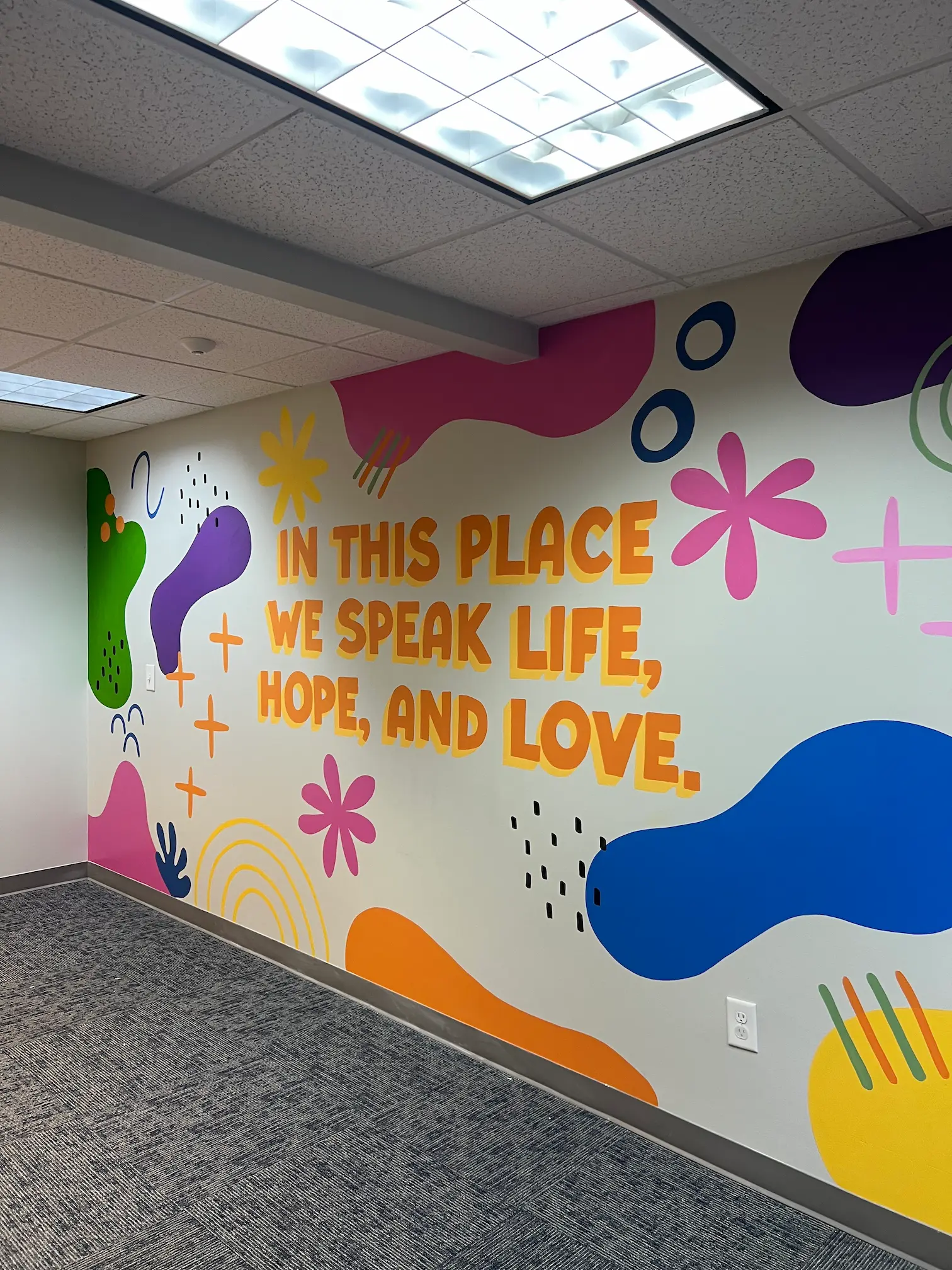
8 Ways Murals Can Improve the Patient Experience in Healthcare Facilities
Walking into a healthcare facility can feel a little intimidating.
There are unfamiliar rooms, medical equipment, signs everywhere, and a lot of white or neutral walls. For someone who is already nervous about an appointment, the space itself may not feel particularly welcoming.
A custom mural can change that.
I am Elise Garcia, an Atlanta mural artist. I create custom, hand-painted murals for restaurants, cafés, shops, gyms, studios, offices, and other businesses.
Healthcare facilities can also use artwork to make their spaces feel warmer, more welcoming, and more connected to the people who visit them.
Looking for a mural for your healthcare facility? Learn more about my custom murals for clinics and healthcare facilities or call (678) 910-0591 to talk about your healthcare facility space.
Why Can Murals Improve the Patient Experience?
Think about the last time you had to wait somewhere.
The room around you probably affected how the experience felt.
A bright, welcoming space can feel completely different from a room with empty walls and harsh lighting.
In a healthcare facility, those details can become even more noticeable because patients may already be feeling nervous, uncomfortable, or uncertain.
Researchers have found that visual artwork in healthcare settings can provide positive distraction and improve patients’ experiences and well-being.
1. A Mural Can Make a Healthcare Facility Feel More Welcoming
First impressions are SUPER-important.
Walking into a doctor’s office with blank walls and very little decoration can make the space feel cold. Adding a colorful piece of artwork immediately gives patients something more inviting to look at.
Imagine a family practice with a large botanical mural behind the reception desk.
The room is still a medical office. The reception desk is still there. Patients still have to check in.
But the atmosphere feels different.
Warm colors, natural imagery, or a cheerful design can make the reception area feel more thoughtful and welcoming.
2. Patients Have Something Interesting to Look At
Waiting rooms are often full of people who have nothing to do.
Some look at their phones. Others read a magazine. A child might start asking when they can leave.
A mural gives the room another point of interest.
Maybe the wall shows a peaceful garden filled with flowers and birds. Perhaps a children’s clinic has a colorful jungle scene with animals hidden throughout it. A wellness practice could use flowing shapes, plants, and soft natural imagery.
Instead of staring at an empty wall, patients have something to notice.
3. Murals Can Make Children’s Healthcare Spaces More Fun
For children, a trip to the doctor or dentist can feel like a big deal.
Everything is unfamiliar. The rooms look different from home. Medical equipment can seem strange. Even sitting in the waiting room can feel like a long time.
A playful mural can give children something familiar and fun to focus on.
Picture a pediatric office with friendly animals painted across the walls. Maybe there are colorful fish swimming around a children’s dental office, or a bright garden filled with butterflies and flowers.
Now the room has something to talk about.
A child might point out their favorite animal. A parent might ask them to find something hidden in the artwork. The wall becomes part of the experience instead of simply being an empty surface.
4. Artwork Can Make a Facility More Memorable
What makes one business easier to remember than another?
Sometimes it is a very small detail.
You might remember the café with the giant flower mural. Or the restaurant with the colorful painted wall. Or the shop with the funny character near the entrance.
Healthcare facilities can create those same kinds of memories.
Someone might describe a pediatric clinic as “the one with the big animal mural.” Another patient might remember a therapy center because of its beautiful nature wall.
5. A Mural Can Bring More Personality to a Clinical Environment
Healthcare facilities have to be functional.
There are waiting areas, reception desks, examination rooms, hallways, signs, doors, and equipment. All of those things serve an important purpose.
That does not mean the space has to feel completely impersonal.
Artwork can bring some personality into an otherwise clinical environment.
6. Local Artwork Can Help a Facility Feel Connected to Its Community
A healthcare facility is part of its neighborhood.
Why not let the artwork reflect that?
An Atlanta clinic could incorporate local plants, landscapes, architecture, or other details inspired by the city. A community healthcare center might want a mural that represents the people and character of its neighborhood.
The connection does not have to be obvious.
You do not need to paint the Atlanta skyline across the entire wall.
Sometimes a few local details are enough to make the artwork feel like it belongs in the community.
7. Murals Can Make Large Empty Walls More Useful
Healthcare facilities often have plenty of wall space.
Long hallways are a good example.
Patients may walk down the same hallway several times during a visit. Without artwork, the space can feel plain and repetitive. A mural gives that wall a purpose.
The same idea can work in a waiting room, reception area, children’s play space, therapy room, or entrance.
8. A Thoughtful Mural Can Make the Space Feel More Human
At the end of the day, healthcare is about people.
Patients are people. Families are people. Doctors, nurses, therapists, and reception staff are people too.
A blank wall does not necessarily communicate much.
Artwork can.
A hand-painted mural adds something personal to the environment. It shows that thought went into how the space looks and feels, not just how it functions. That can be meaningful in places where people may already be feeling anxious or vulnerable.
What Makes a Healthcare Mural Work?
A large mural can certainly make an impression. But size is not what makes a healthcare mural successful.
The artwork needs to fit the people, the room, and the experience.
1- It Matches the Feeling of the Space
A children’s clinic can have a completely different personality from a medical office for adults.
Bright colors and playful characters might work beautifully in a pediatric space. A counseling office may benefit from something softer and calmer. A wellness center could use natural imagery and peaceful colors.
The artwork should support the atmosphere rather than compete with it.
2- It Gives Patients Something to Discover
A mural does not have to be complicated to be interesting.
Small details can make a big difference.
A child might notice a butterfly tucked into a garden. Someone walking down a hallway might spot a familiar Atlanta landmark. Another patient may see something new each time they pass the wall.
Those little details give people a reason to stop and look.
3- It Works With the Room
A mural should make sense with everything around it.
Furniture, doors, windows, lighting, signs, reception desks, and other features all become part of the design.
A large wall may be perfect for one big scene. A narrow hallway might need something more continuous. A reception area may need artwork that works around the desk instead of fighting with it.
Before painting, I look at the space and think about how the mural will work with its surroundings.
4- It Uses the Right Colors
Color can completely change how a room feels.
That does not mean every healthcare mural needs to be soft or neutral.
A pediatric office might benefit from bright, cheerful colors. A waiting room could use warm, welcoming tones. A wellness space might feel better with greens, blues, and other nature-inspired colors.
The important part is choosing colors that make sense for the space and the people using it.
5- It Feels Appropriate for the Patients
Who will see the mural every day?
That question should influence the design.
A mural created for young children can be playful and imaginative. Artwork in an adult medical practice may need a more sophisticated look. A rehabilitation center could use movement, nature, or other imagery connected to its purpose.
There is no single “healthcare mural” style.
The right design depends on the facility.
6- It Is Made for the Wall
Not every wall is the same.
An indoor hallway has different needs from an exterior wall. A busy waiting room can experience more everyday wear than a quiet office. Some spaces receive strong sunlight, while others do not.
Wall preparation, paint quality, surface type, and protective finishes all matter.
The mural should be created for the actual environment rather than treating every project exactly the same way.
Let’s Make Your Healthcare Space More Welcoming!
Healthcare facilities do a lot for the people who walk through their doors.
The walls can play a small part too.
A custom mural can bring color to a waiting room, personality to a reception area, fun to a children’s clinic, or warmth to a long hallway.
For Atlanta healthcare facilities, a blank wall can become a beautiful part of the environment instead of simply being something patients walk past.
Does your healthcare facility have an empty wall that could use a little more personality?
I can turn it into a colorful, hand-painted mural made specifically for your space and the people who visit it.
Explore my Mural services in Atlanta. Let’s create a wall your patients will notice, enjoy, and remember.

I’m Elise Garcia, a professional wall doodler.
Part-time ladder acrobat, full-time color enthusiast. I paint murals that bring personality and life into spaces people walk past every day.